2025 Lake Tahoe Clarity Report released
Water clarity at Lake Tahoe continues to hold steady
Staring into the depths of Lake Tahoe, you might think the view goes on forever. But researchers at the UC Davis Tahoe Environmental Research Center have been tracking precisely how far a person can see through the famed lake’s waters for nearly 60 years and sharing the results in the annual Lake Tahoe Clarity Report.
The 2025 Lake Tahoe Clarity Report, released today, shows that the annual average clarity remains at a plateau, neither significantly improving nor declining compared to previous years. The annual average was 69.2 feet in 2025. That is 7 feet clearer than last year’s average of 62.3 feet, but not statistically different from recent years, mostly due to a continuing trend of relatively low clarity during summer.
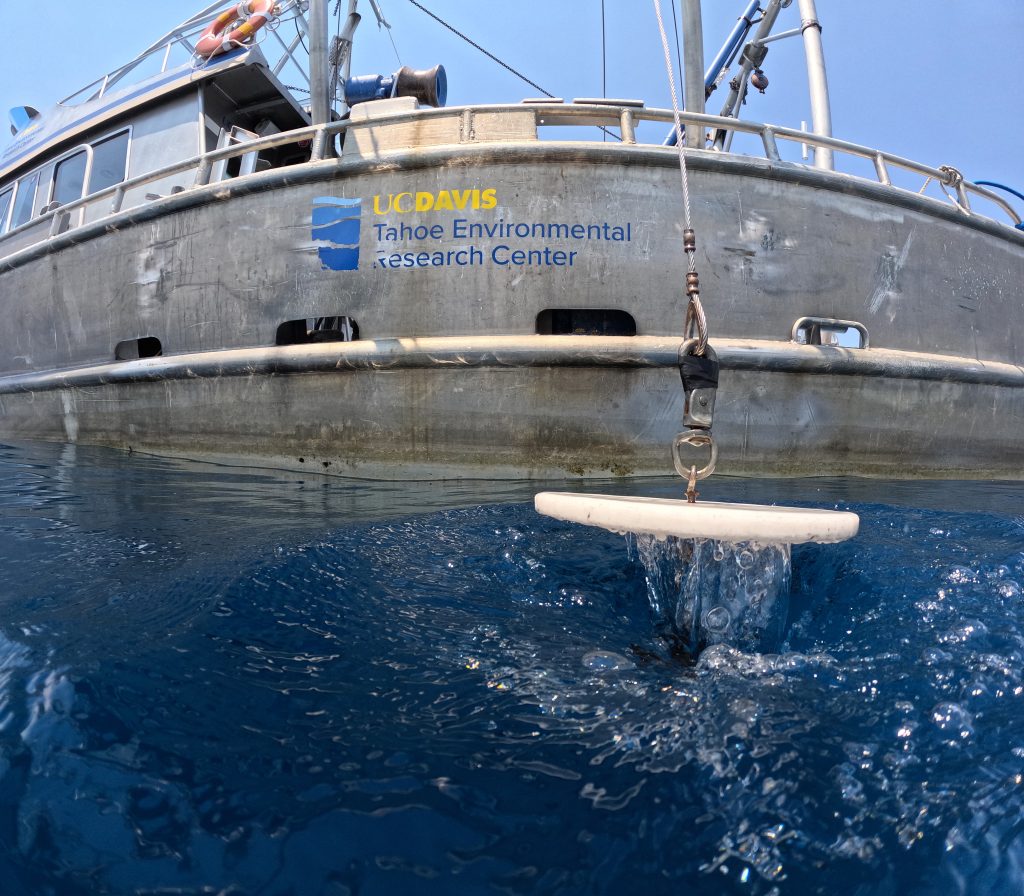
Clarity is measured as the depth to which a 10-inch white disk, called a Secchi disk, remains visible when lowered into the water. Under the Lake Tahoe Environmental Improvement Program, the states of California and Nevada, along with more than 80 public and private organizations, are actively working to restore lake clarity to its historic 97.4 feet, which was the average level recorded between 1967 and 1971.
“Water clarity rapidly declined through the late 1990s and then leveled off to what we see today,” said Stephanie Hampton, director of TERC and a UC Davis professor in the Department of Environmental Science and Policy.”I know it is tempting to feel hopeful about an average annual 2025 depth that is slightly deeper than last year, but it is not time to celebrate yet. Statistical analysis shows us that this year was not significantly different from last year, and lake clarity has not substantially improved for decades. We are working with our partners across the basin and employing new lines of inquiry and scientific tools to better understand the dynamics at play in this complex, beloved watershed.”
In 2025, UC Davis scientists took 20 readings at Lake Tahoe’s long-term index station and 12 readings from the mid-lake index station.
Expanding clarity research
Past research indicates that fine particles in the upper waters are the main factor governing lake clarity. As in previous years, water clarity in 2025 correlated with a seasonal peak of fine particles. In 2025, TERC researchers began lining up decades of data on the potential drivers of clarity, alongside Secchi depth, to better examine which drivers of water clarity may shift from year to year. These drivers could include sediment and debris entering the lake from streams or the atmosphere, as well as the complex interplay of phytoplankton and tiny picoplankton that may cloud the water.
“Over the past several decades, water clarity has plateaued rather than improved,” Hampton said. “Why isn’t clarity improving more? To really answer that question and find out what is currently driving water clarity, examining the nature of the particles is a key research priority.”
In 2026, researchers will use new techniques to investigate the role of phytoplankton, including their tiniest component — the picoplankton — as well as the lake’s physical dynamics. They will deploy new imaging technology to visualize particle aggregation in unprecedented detail.
These approaches aim to combine new science and engineering perspectives to understand the interconnected system of Lake Tahoe and help shape the future of clarity research at the lake.
Moments of clarity
UC Davis has been measuring clarity and other health indicators at Lake Tahoe since 1968. While clarity is just one measure of the health of the watershed, TERC’s documentation of clarity loss in the 1950s and 1960s became central to efforts to protect the watershed from pollution and unplanned development.
UC Davis works with the Tahoe Science Advisory Council and partners across the Tahoe Basin to help inform policymakers and the community on strategies to protect the lake and stabilize the decline in clarity that occurred following the mid-20th century development boom.
Partly in response to TERC’s early findings on Lake Tahoe’s clarity loss, Nevada and California created the Tahoe Regional Planning Agency (TRPA) through a unique bi-state compact in 1969 to lead the collaborative effort to protect and restore Lake Tahoe.
“Lake Tahoe’s greatest conservation achievements have come from collaborative implementation of science-based solutions,” TRPA Executive Director Julie Regan said. “This clarity report clearly documents progress as well as the challenges we currently face. With more than 80 public and private partners working together, we will continue advancing the restoration of Lake Tahoe’s spectacular environment.”
TRPA funds the Lake Tahoe Clarity Report and continues to look to the Tahoe Science Advisory Council and member institutions to help prioritize restoration projects and guide the region toward a clear, sustainable future.










Support Local Journalism
Support Local Journalism
Readers around the Lake Tahoe Basin and beyond make the Tahoe Tribune's work possible. Your financial contribution supports our efforts to deliver quality, locally relevant journalism.
Now more than ever, your support is critical to help us keep our community informed about the evolving coronavirus pandemic and the impact it is having locally. Every contribution, however large or small, will make a difference.
Your donation will help us continue to cover COVID-19 and our other vital local news.