25 Years Later: Lessons Learned from the Martis Fire
On the morning of June 17, 2001, Father’s Day, a campfire that wasn’t fully extinguished escaped and ignited one of the most dramatic wildfires in Truckee’s history. Driven by wind funneling down the canyon, low humidity, and critically dry fuels after a below-average snowpack season, the Martis Fire tore through the landscape and bore down on the small community of Floriston along the Truckee River. The numbers are still staggering to think about: 14,000 acres burned and $18 million in damage.
But it could have been far worse. The fire was stopped in its tracks along a ridge in Floriston, thanks in part, to the unglamorous work of a single man. Darin Bue had bought his property on Tamarack Street in 1993. Even then, before defensible space was a widely understood concept, something told him the forest pressing up against his home was a problem. He started cutting, piling, and doing some broadcast burning on the steep slope behind his house.
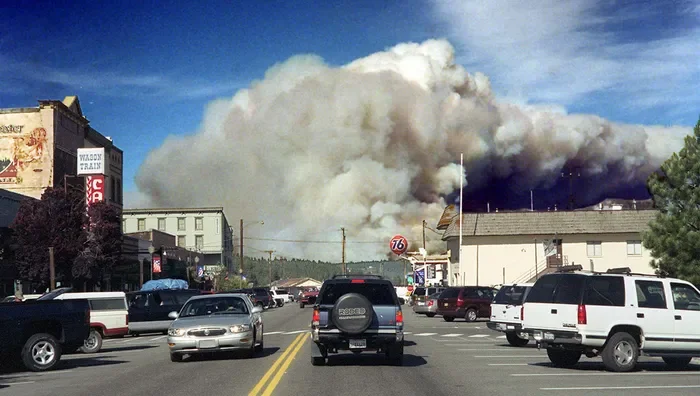
“I got a lot of friction for that,” says Bue. “But the volume of material up there was overwhelming. I had an instinct about it and I just kept pecking away.” Ten years later, the Martis Fire arrived. As flames roared down the canyon, firefighters were able to set up within his cleared defensible space and use it as a staging ground to deflect the fire away from both his home and the town.
“That was one key factor that saved the town from burning down,” says Bue. Topography played a role, too. A rotor effect created an eddy effect that actually pulled embers away from Floriston rather than onto it, but the defensible space gave crews the foothold they needed to halt the flames in their tracks.
“This is why we spend so much time, energy and money investing in wildfire mitigation,” said Eric Horntvedt, Wildfire Prevention Manager with Truckee Fire Protection District. “Defensible space is the front line of protection against these damaging wildfires.”
Bue has continued the work ever since, expanding his fuel reduction efforts with the blessing of neighboring landowners, replacing aggressive snow brush and bitter cherry with plants that are more fire resistant. Most recently, he even enlisted a pack of goats to help manage the vegetation. “I think it’s important to have a relationship with the land,” says Bue, “and an understanding of what makes a forest healthy or unhealthy. The signs are all out there and easy to see if you look.”
Today’s Warning Signs
Drive through Truckee today and the landscape is deceptively reassuring, green hillsides, water still moving through creeks, soil that feels damp underfoot. Dawn Johnson, a meteorologist with the National Weather Service office in Reno, says this winter season was one of the strangest she’s seen. Liquid precipitation, that was made up of rain and snow combined, actually came in near normal at roughly 105% across the Tahoe and Truckee basins. But the storms were so warm that most of what fell came down as rain rather than snow.
“Your eyes are going to deceive you,” says Johnson. “The fact that we greened up so early and the snow melted so early means we’re not going to have the water when we typically see it, so fuels are going to be ready to burn earlier.”
That distinction matters. In the Sierra Nevada, snowpack is not just a scenic backdrop, it is a slow-release water storage system that feeds streams, rivers and soil moisture through the dry months. This year, that reservoir peaked around February 25 and melted off weeks ahead of schedule, with peak runoff arriving in late February and early March instead of the typical April-to-June window.
Comparing 2001 to 2026
There are some similarities between the two years, but it’s not quite a perfect match. Johnson says the two years show similar snowpack percentages by spring: the Truckee Basin sat at roughly 57% of normal as of April 1, 2001, with a peak snow water equivalent (SWE) of 69% on March 13, 2001. This year, the peak SWE in the Truckee Basin was 71% on Feb. 25, 2026. It was also a warm spring. 2001 was the eighth warmest spring on record. This year was the third warmest. While 2001 was itself a drought year, the years leading up to it were actually very wet.
“The melt off this year was significantly earlier, February-March,” adds Johnson, “and while there was some melt in March-April 2001, there were also storms into mid-late April, and the biggest snowmelt came late April and early May.”
One of the biggest differences is that this year we had near normal precipitation (105% for the water year as of June 1) and a snow drought from the overall warm winter, while in 2001, the Lake Tahoe and Truckee Basins were only at 60% of normal for precipitation as of June 1, 2001.
“It was dry, but it was not record-breaking dry,” Johnson says of 2001. “It was not shattering records, even with the drought.” The snowmelt that spring also followed a more typical curve, with runoff occurring in April and May and some additional late-season storms providing relief.
What made the Martis Fire so dangerous was a convergence of other factors: wind that aligned perfectly with the canyon topography, critically low humidity and an unstable atmosphere, conditions that can occur in any year regardless of snowpack. Those conditions are wildcards, but they are increasingly forecastable thanks to modern technology.
A similar convergence is happening right now, even if each individual factor isn’t quite the same. What may be most concerning about 2026 is not any single metric but the combination of factors coming together simultaneously, something Johnson said is genuinely unprecedented in her experience.
Wet years in recent seasons created a large and lush crop of lower-elevation grasses. Because snowpack was minimal at lower elevations this year, that grass crop never got compacted by snow, leaving it standing, aerated, and primed to burn. Meanwhile, the early snowmelt exposed timber fuels weeks ahead of schedule, accelerating their drying.
“Normally, most years, we either see the large fuels dry out, or we see the fine fuels dry out, both are problematic,” says Johnson. “I’ve talked to fire chiefs who’ve told me, in 25 years, they’ve never seen anything like this, where both large and fine fuels are at play. Typically, it’s one or the other.”
The late spring rains of recent weeks have provided some relief, but Johnson says it’s just delaying the inevitable. She also pushed back on the notion that fire season has clear boundaries. “We don’t have an off season anymore,” she said. “We just have high season and low season.” Fall, she noted, is a particular blind spot when people tend to relax as temperatures drop, but that is precisely when large wind events arrive and dry fuels are at their most dangerous after a long summer.
What Residents Can Do Right Now
The anniversary of the Martis Fire is, above all, a reminder that catastrophic fires don’t only happen in peak summer, and that individual action genuinely matters.
The Truckee Fire Protection District offers a wide array of programs, funded through Measure T, that offer help for the community, from home hardening rebates to free green waste disposal. “The biggest takeaway from the Martis Fire is for people to just pay attention and take extra care to prevent accidental fire starts,” says Horntvedt. “Be like Darin Bue and take preventative measures to keep your property and your community safe.”
A practical check list of to-do’s:
- Create defensible space now, before conditions worsen. Don’t wait for a red flag warning.
- Use the FREE green waste pick-up program. Funded by Measure T, this free resource runs through October. Don’t forget about green waste dumpster rebates as well for bigger jobs.
- Cash in on home hardening rebates, it covers up to 50% of project costs up to $2,000.
- Don’t be the cause of the next accidental fire! Drown your campfire completely before leaving your site, avoid using power equipment during the hottest and driest part of the day, don’t park over dry grass, make sure trailer chains are properly stowed so they don’t drag and spark on the pavement, and NEVER toss cigarette butts out of your window.
- Go to tahoealerts.com and enroll your family in emergency alerts. Download the Watch Duty App at watchduty.org
Visit http://www.truckeefire.org/wildfireprevention for a ton of resources and programs to help residents prepare and make their home fire safe and create a wildfire-resilient Truckee.





Support Local Journalism
Support Local Journalism
Readers around the Lake Tahoe Basin and beyond make the Tahoe Tribune's work possible. Your financial contribution supports our efforts to deliver quality, locally relevant journalism.
Now more than ever, your support is critical to help us keep our community informed about the evolving coronavirus pandemic and the impact it is having locally. Every contribution, however large or small, will make a difference.
Your donation will help us continue to cover COVID-19 and our other vital local news.