A deeper look into Castle Peak’s deadly avalanche: the regulatory landscape
TRUCKEE, Calif. — What began as a guided backcountry ski trip near Castle Peak ended in the deadliest avalanche in Tahoe’s recorded history, leaving eight people dead and one unaccounted for. The incident, which came during a storm that had been widely forecast, is raising urgent questions about safety standards and regulatory oversight for commercial backcountry guiding operations.
The Breakdown
The avalanche occurred Tuesday on a north-facing slope near Perry Peak above Frog Lake, just east of Castle Peak in the Central Sierra Nevada, according to the Sierra Avalanche Center and the Nevada County Sheriff’s Office.
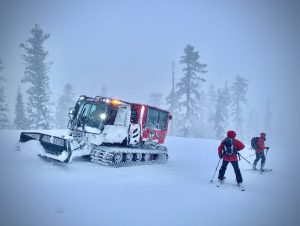
Officials said the group involved was concluding a three-day guided backcountry trip to the Frog Lake huts. The trip was operated by Blackbird Mountain Guides, one of several companies offering guided backcountry ski and splitboard excursions in the region. Sheriff Shannan Moon said the group was returning to the trailhead when the avalanche occurred.
The Sierra Sun had began tracking the forecasted storm cycle on Feb. 12, when OpenSnow identified it as California’s first significant system since the holidays. At that time, forecasts projected 3 to 5 feet of snow across Tahoe ski areas and along the west slope of the Sierra. The guided group left on February 15.
In a Facebook post on Sunday, Feb. 15 — the day before the avalanche — Blackbird Mountain Guides cautioned followers about abnormal and hazardous avalanche behavior, urging them to “pay close attention” to the Sierra Avalanche Center forecast and to exercise extra caution.
The Sierra Sun reached out to Blackbird Mountain Guides seeking further comment and additional detail about the decision-making process that led to the group traveling during the forecasted storm, but did not receive a response.
A Complex Regulatory Landscape
Much of the terrain surrounding Castle Peak lies within Tahoe National Forest, managed by the U.S. Forest Service. Any commercial outfitting or guiding operation on national forest lands is required to obtain a special use authorization.
Permits for these uses must pass multiple levels of screening. Among other criteria, applicants must comply with federal, state and local laws; align with the applicable forest plan; avoid creating substantial public safety risks; and be deemed in the public interest. Conducting commercial activity on national forest lands without authorization may violate federal law.
While skiers typically reach the Frog Lake huts by traveling through Tahoe National Forest — which requires following federal permitting rules — the huts themselves sit on privately owned land.
Who Manages the Frog Lake Huts?
The Frog Lake huts are privately owned and managed by the Truckee Donner Land Trust, which, along with partners including The Nature Conservancy, Trust for Public Land, and the Northern Sierra Partnership, acquired the 3,000-acre property in 2020 as part of a large conservation effort. Before the acquisition, the land had been closed to the public for nearly a century.
The huts sit beneath Frog Lake Cliff between Euer and Carpenter valleys on the east side of Castle Peak. The property is open to winter access by ski and snowshoe, and to foot and bicycle travel in summer.
“Winter wilderness travel is not to be taken lightly — people die every year in the backcountry,” the land trust cautions in its visitor materials. It provides guidance noting that all routes in the area carry some level of avalanche risk, which are rated using the Avalanche Terrain Exposure Scale.
The land trust also encourages visitors with safety concerns to hire experienced guides and notes it partners with guide services that can accompany guests to the huts. Among those partners is Blackbird Mountain Guides, the company that led the group involved in Tuesday’s avalanche.
The Sierra Sun reached out to the Truckee Donner Land Trust for clarification on how it selects and oversees its partnered guide companies but did not receive a response.
In a statement released Feb. 18, Blackbird Mountain Guides said all guides with the group were trained or certified by the American Mountain Guides Association in backcountry skiing. The company added that each guide was also an instructor with the American Institute for Avalanche Research and Education, which it described as the industry standard for avalanche education.
“There is still a lot that we’re learning about what happened. It’s too soon to draw conclusions, but investigations are underway,” the statement read.



Support Local Journalism
Support Local Journalism
Readers around the Lake Tahoe Basin and beyond make the Tahoe Tribune's work possible. Your financial contribution supports our efforts to deliver quality, locally relevant journalism.
Now more than ever, your support is critical to help us keep our community informed about the evolving coronavirus pandemic and the impact it is having locally. Every contribution, however large or small, will make a difference.
Your donation will help us continue to cover COVID-19 and our other vital local news.