Douglas County’s chief elections officer discusses SAVE Act implications
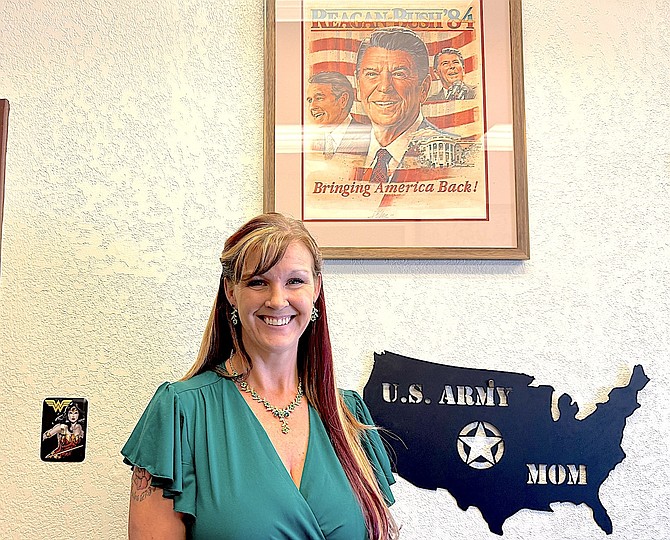
As the U.S. Senate debates the Safeguard American Voter Eligibility Act, Douglas County Clerk-Treasurer Amy Burgans has been preparing for the possibility it will be enacted into law.
She said the Act as currently written won’t affect voters who are already registered.
“Everyone who is on the rolls, will stay on the rolls,” she said.
Because the Act takes effect upon passage, states will have 30 days to enact laws implementing it. In Nevada, that means a special session of the Legislature, Burgans said in an interview with The Record-Courier on Tuesday morning.
HR 22 being debated in the U.S. Senate revises the National Voter Registration Act of 1993.
“The key provisions would require states to require documentation such as passport or birth certificate, or military with proof of birth in the U.S. to allow an individual to register to vote,” she said.
Noncitizens would be removed from voter rolls, and it would allow private individuals to sue, and if successful, impose criminal penalties on officials who registered voters without the required proof.
Concerns about what additional documentation women registering to vote would need if the name on their photo ID doesn’t match their birth certificate aren’t directly addressed in the bill.
“The law does not specify that; however, my assumption would be that if the name on the photo ID did not match the proof of citizenship (Birth Certificate), then we would need other documents, such as a marriage license, to show that it is the same person,” she said.
Burgans pointed out that Nevada’s Real ID is not proof on its own of citizenship under the act.
“It is proof of who you are,” she said. “I have a very close friend who is not a citizen and is not able to vote, yet she has a real ID because she has proven who she is.”
A drivers license, military ID or Native American ID could be paired with a certified birth certificate to allow someone to register, but the birth certificate has to be stamped.
“These documents must be presented in person,” she said. “That’s a problem because there is no wriggle room for our military, disabled or tribal members. The only thing the law states is that reasonable accommodations will be made for an individual with a disability but does not define what those are. Reasonable accommodations are always something we struggle with when the law is vague.”
Burgans said that poses a problem for servicemembers, like her son and daughter-in-law, who are registered to vote in Nevada but are living in Georgia.
“How would they present in person?” she said. “That bothers me. Or for tribal members. In Douglas County, our tribe is in the middle of the county, but in Elko County and Nye County there are tribal members who live hours off the beaten path. They would have to come in to register.”
Burgans said that the goal is to prevent noncitizens from voting in elections, but she feels that the law might be more than required.
“There has been a lot of talk about the large number of noncitizens on the voter rolls across the nation, but people need to understand there are some states and jurisdictions that allow noncitizens to vote in nonfederal elections,” she said.
Nevada doesn’t allow noncitizens to vote at all, but Arizona, Maryland and Washington DC allow noncitizens to vote in local elections.
“In those states that have done a deep dive into their voter rolls, there has been no evidence of widespread fraud,” she said. “I’m not condoning noncitizens voting. I’m just saying it’s not as big an issue as some have claimed.”
Her concern is that the law will raise so many barriers to voting that people aren’t willing to register.
“Does the law make sense considering the barriers that it will create for people to register to vote versus the amount of fraud we are trying to eliminate?” she asks. “Not as it is currently written or in the manner it is being rolled out.”
A constitutional amendment requiring voters to show an ID when they vote in person is on November’s ballot.
Question 7 passed in 2024, and if it passes in November it will go into effect for elections in the future.
The question allows those voting by mail to verify their identity by using the last four digits of their drivers license or Social Security Number.
She said that the association of election clerks is working on drafting legislation for the 2027 session to implement the amendment.



Support Local Journalism
Support Local Journalism
Readers around the Lake Tahoe Basin and beyond make the Tahoe Tribune's work possible. Your financial contribution supports our efforts to deliver quality, locally relevant journalism.
Now more than ever, your support is critical to help us keep our community informed about the evolving coronavirus pandemic and the impact it is having locally. Every contribution, however large or small, will make a difference.
Your donation will help us continue to cover COVID-19 and our other vital local news.