Marathon has had long run at Tahoe
ALL |
Considering the first venture at establishing a Lake Tahoe marathon back in the 1970s, there was plenty of uncertainty when Les Wright resurrected the long-distance race in 1996.
But Wright made the present Lake Tahoe Marathon more than a single race, and navigated a logistical and bureaucratic tightrope by making his baby a lakewide event.
What started as a marathon, half-marathon, 10K, 5K and kids’ fun runs in its first year has evolved into a potpourri of endurance competitions. In recent years, Wright has added a triple marathon, ultramarathon, kayaking, cycling, speed golf and swimming to the festivities.
He didn’t let history repeat itself, as the first Lake Tahoe Marathon was canceled after a six-year run from 1977-1982. Part of that marathon’s undoing was that only a small portion of Lake Tahoe was used for the race. Race organizers were limited to a course from Incline Village to Spooner Summit and back.
Wright has incorporated the entire 72-mile highway around Lake Tahoe into his races, meaning an out-and-back course hasn’t been necessary.
There was some doubt if Wright’s event would survive after a first year that attracted 350 competitors. The winning time for the 26.2-mile race that initial year didn’t draw national attention: Brendon O’Donnell of Irvine won with a time of 3 hours, 9 minutes and 27 seconds, and women’s winner Kathy D’Onofrio-Wood of Truckee broke the tape at 3:36:52.
The runners didn’t have the comfort of a road closure that they have today.
“I just ran up the middle of the road and made the cars stop,” D’Onofrio-Wood said.
Wright’s first marathon also lacked a dramatic finish line. The race ended unceremoniously near the city boundary on Highway 89. The finish line was moved to its present home of Pope Beach the following year, but not without some resistance.
“After running the whole marathon down the most beautiful road in the world, finishing at Pope Beach put the whipping cream on the top,” Wright said at the time.
The U.S. Forest Service and California Department of Fish and Wildlife attempted to prevent the marathon from finishing at Pope Beach, claiming it disturbed the eagle habitat in the area. The disagreement reached a head in 1998 when Wright was cited for violating his permit.
The sides, however, came to terms the following year by moving the finish line at the Pope Beach parking lot to the west end of the lot.
The event’s growth in the first four years gave Wright the knowledge that a marathon could work. By 1999, the number of participants grew to 2,000, giving Wright a marginal profit of about $5,000.
Wright, however, wasn’t content. By attending other marathons around the country, he implemented some ideas and events that have filled up the city on a weekend that normally would be relatively dead.
“We want to bring people into town during our slow season and fill up the rooms,” said Wright, who once claimed that his marathon injected $3.65 million into the local economy.
The Douglas County Commission contributed $10,000 in 1998, so the marathon could be televised for the first time by Fox Sports. A year later in conjunction with the TV coverage, Wright added a small purse and a battle-of-the sexes competition to the marathon. He gave the elite women a 30-minute head-start ahead of the elite men to compensate for the differences in the genders’ world records. The first man or woman to cross the finish line was guaranteed a winner-take-all prize of $500.
As it turned out, former Whittell High School teacher and coach Katie Gengler took home the first prize, and she went on to win the women’s title three times.
Wright has increased the prize money in recent years, and that has piqued the interest of higher-caliber runners. Kenyans won four marathons in a five-year period starting in 2001.
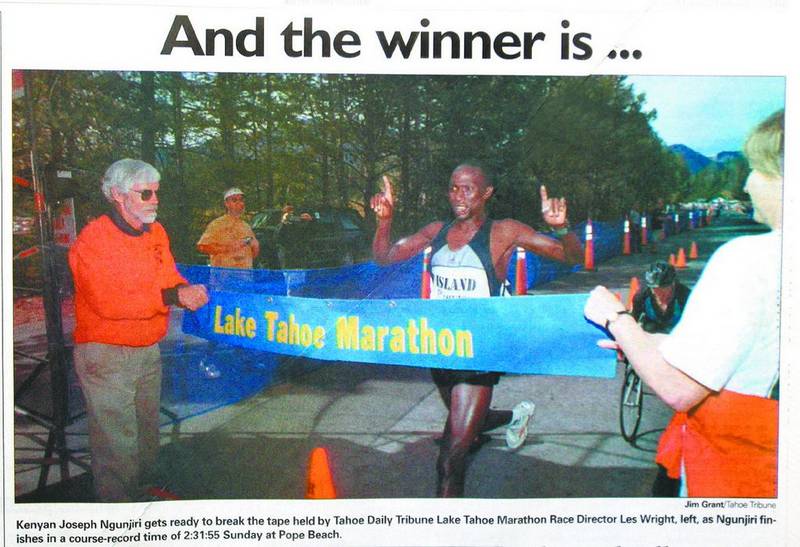
Joseph Maina Ngunjiri’s winning time of 2:30:55 in 2001 still stands as the course record. Wright has tried to encourage a new record by offering cash incentives. Kenyan John Weru, who won back-to-back titles, came the closest by completing the race in 2:35:05.
“To have a racer like John is a testament to how far the Lake Tahoe Marathon has come,” Wright said. “I told John if he breaks his 2003 time, I’ll give him a $250 bonus.”
While the marathon has attracted most of the attention, some of the other events have had their moments.
In 2004, 81-year-old Helen Klein of Rancho Cordova brought notoriety to the Tahoe Triple by completing three marathons in three days.
“I’ve done a lot of multiday races, six-day races and five-day races, and this will be the shortest multiday race I’ve done,” Klein said before embarking on her 78.6-mile adventure.
In 2005, a 70-year-old Silver Springs, Nev., man collapsed and died while participating in the 10K. He is the only competitor to have died in the marathon’s first 12 years.
That same year, spectators were treated to the first exciting finish in the battle-of-the-sexes race. Samuel Githinji of Tucson, Ariz., overtook Kristi Arthur of Reno several hundred yards from the finish line for a three-second victory.
“I heard the feet coming,” Arthur said. “At the very end, that’s where you have to dig down deep and give it something extra. I gave it what I had, but there wasn’t enough in me to give. If I had one more gear, it might have been a photo finish.”
South African Johan Oosthuizen set a new world record by running three marathons in three days with a total time of 8:10:79. He beat the old mark by about 12 minutes.
There have been some characters, too. Reno’s Lynryd Skynrod provided the antithesis to an endurance athlete by dangling a cigarette from his lips after winning the 2007 Tahoe Triple. Skynrod claimed to cut his cigarette intake to a pack a day before winning the Tahoe Triple in 8:35:00.
The marathon has grown from a one-day event to four days. More than 98 percent of the 3,000 competitors are from out of the area.
“I would like it to be a little bit bigger,” Wright said in 2006. “Our biggest thing is word of mouth and me going out to expos around the country. That’s where we get (new) people coming in.”




Support Local Journalism
Support Local Journalism
Readers around the Lake Tahoe Basin and beyond make the Tahoe Tribune's work possible. Your financial contribution supports our efforts to deliver quality, locally relevant journalism.
Now more than ever, your support is critical to help us keep our community informed about the evolving coronavirus pandemic and the impact it is having locally. Every contribution, however large or small, will make a difference.
Your donation will help us continue to cover COVID-19 and our other vital local news.