TTCF, TRPA align housing findings, highlight regional workforce housing crisis
TAHOE REGION, Calif./Nev. — For the first time, the Tahoe Truckee Community Foundation (TTCF) and the Tahoe Regional Planning Agency (TRPA) have aligned findings from their respective housing needs analyses, revealing consistent and urgent housing challenges across the greater Tahoe region. While the two studies examine slightly different geographies, the results point to the same conclusion: there is a significant mismatch between housing supply and the local workforce’s needs.
“Since 2016, investments in regional data have helped us track progress towards achievable local housing solutions* with the many housing efforts across agencies,” said Stacy Caldwell, TTCF CEO. “This aligned data shows that most unmet need remains on working households, which are essential to our community. This moment calls for continued coordination and locally driven solutions that match the scale of the need.”
Key takeaways
- In-commuters (those who commute into the Tahoe-Truckee area but would prefer to live in the region) represent the largest share of unmet demand,
- 50% of renter households are overpaying for housing, compared to 34% of homeowners,
- 65% of Tahoe – Truckee housing stock is held for seasonal and occasional use,
- 245% – 255% of Area Median Income** (AMI) could be required to purchase a median-priced single-family home in the broader region.
Achievable Workforce Housing Gaps Persist
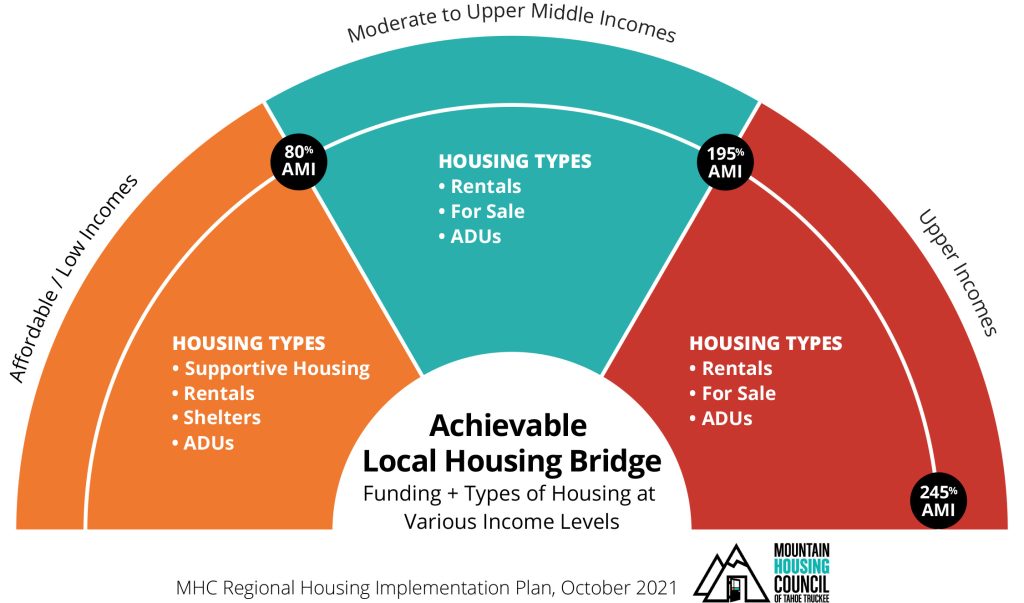
The housing studies show that unmet housing needs continue to impact achievable local housing, from the unhoused to those making 245% AMI, or the “missing middle.” This expanded definition of affordability- originally developed by the Mountain Housing Council in 2021 and adopted by TTCF, TRPA, and regional housing partners- improves our region’s ability to address local housing needs. This unmet need includes those who are inadequately housed (e.g., in overcrowded conditions or substandard housing) as well as those in need of housing, spanning the resident workforce, in-commuters, and seasonal workforce.
Comparing TTCF’s housing data from the 2016 study, affordability has generally worsened throughout the community, with higher incomes being required to afford market-rate housing. The new data for the Tahoe Basin show the same widening affordability gap, although the overall level of housing need has risen only slightly from earlier studies.
In-Commuter Data Suggests Workforce Displacement
TRPA data confirms a substantial number of workers commute into the Basin but would prefer to live closer to their jobs — a pattern that increases vehicle miles traveled (VMT) and affects environmental outcomes. TTCF’s analysis echoes this finding.
Furthermore, TTCF notes that current data primarily capture in-commuters and does not fully quantify residents who have already been displaced from the region, suggesting the true housing pressure may be even greater.
“Housing and environmental sustainability in the Tahoe Basin are deeply connected,” said TRPA Long Range Planning Director Karen Fink. “When workers are forced to commute longer distances, it increases vehicle miles traveled and impacts Basin health. These findings will help inform the next phase of the Tahoe Living initiative.”
Testing Assumptions and Designing Solutions
Both TRPA and TTCF hosted data walks to test the quantitative data against the lived realities and observations of those organizations and agencies that serve the people of our regions. These walks affirmed the data and also pointed to the interventions that are working. For example, Sierra Community House provides one-time rental and utility assistance to help people remain housed during emergencies, the collaborative efforts of Tahoe Truckee Workforce Housing Agency, and free transportation solutions through Tahoe Truckee Area Regional Transport (TART) to aid commuting.
Data Will Continue to Inform Regional and Local Housing Strategies
TRPA will use its findings to guide the Cultivating Community, Conserving the Basin phase of the Tahoe Living policy initiative, currently in the scoping phase of an Environmental Impact Statement. Proposed policies in the environmental analysis include changes to the growth management system that would scale certain regulations and incentives by the size of residential units, something the new data points to as an area of concern and possible driver of environmental impacts. Learn more at http://www.tahoeliving.org/housingassessment.
TTCF will share the results with local housing authorities in Nevada and Placer Counties, the Town of Truckee, and alumni partners of the Mountain Housing Council to help advance locally driven housing solutions. TTCF has facilitated housing needs assessments in 2015, 2016, 2021, and 2023 to accelerate housing solutions in North Tahoe-Truckee. The full report is available at http://www.ttcf.net.




Support Local Journalism
Support Local Journalism
Readers around the Lake Tahoe Basin and beyond make the Tahoe Tribune's work possible. Your financial contribution supports our efforts to deliver quality, locally relevant journalism.
Now more than ever, your support is critical to help us keep our community informed about the evolving coronavirus pandemic and the impact it is having locally. Every contribution, however large or small, will make a difference.
Your donation will help us continue to cover COVID-19 and our other vital local news.