Fire and ice—Study explores Caldor Fire’s effect on snowpack

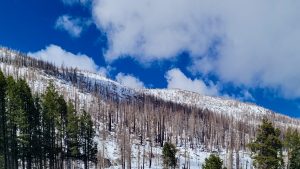
GREATER LAKE TAHOE AREA, Calif. / Nev. – A recently published study on the 2021 Caldor Fire burn scar is shedding light on how fires can impact snowpacks.
Often referred to as the “frozen reservoir”, the Sierra Nevada snowpack provides 30% or more of California’s water. As wildfires in the west are not only burning increasingly more acreage, but are also going higher in elevation—including into areas where snowpacks occur—it’s raising questions about what that means for one of the state’s biggest water resources.
Marianne Cowherd set out to find answers, studying the Caldor Fire area during the 2022-2023 winter along with others, including UC Berkeley Central Sierra Snow Lab Director Andrew Schwartz.
“These fires are massively problematic for us trying to ensure we’re managing our water correctly,” Schwartz said, “and so that’s why it’s important that we study how they affect different snow processes.”
Over the last 100 years, monitoring has allowed water managers to measure the amount of snowfall in a catchment area and roughly know how much water it will add to reservoirs.
This study found that fire could change that.
“The problem is when you burn large sections of the catchment, like the Calder Fire did,” Schwartz explained, “it shifts how much those measurements can actually tell us now.”
That’s because the fire affects key landscape features such as forest cover and vegetation, while leaving a black carbon trail.
Together, these impacts alter snow accumulation and persistence in burned areas compared to pre-fire conditions, the study says.
But the study found that the case isn’t as cut-and-dry as there being more or less snow between burnt and unburnt areas.
“It’s a lot more complex than that,” Schwartz said.
Key features such as aspect (whether the area is north, south, west or east facing), elevation and burn severity all play a role.
In fact, the study found that burn severity, rather than comparisons between burned and unburned, had a greater effect on the snowpack.
High-severity regions generally held less snow and melted more quickly than unburned or low-severity regions.
In contrast, low-severity regions held more snow at high elevations and slightly less at low elevations.
An example where aspect comes into play is the finding that north-facing slopes at mid-to high elevations had snowpack accumulations that benefited from fire, especially in areas of low and moderate severity.
The snowpack decreased at other elevations, aspects and fire severities.
Understanding just how much these factors will change water resource measurements will take time. However, the five years since the Caldor Fire have started to offer indications.
Generally, Schwartz explained that it will change the amount of melt at various times of the year and the geographic distribution, so some reservoirs will receive more water than in the past, while others will receive less.
“[The paper] really shows the complexity of these areas,” he said, “and the advanced thinking that we have to have when trying to manage the water that’s coming out of these areas.”



Support Local Journalism
Support Local Journalism
Readers around the Lake Tahoe Basin and beyond make the Tahoe Tribune's work possible. Your financial contribution supports our efforts to deliver quality, locally relevant journalism.
Now more than ever, your support is critical to help us keep our community informed about the evolving coronavirus pandemic and the impact it is having locally. Every contribution, however large or small, will make a difference.
Your donation will help us continue to cover COVID-19 and our other vital local news.