Summit in Tahoe discusses nature-based solutions to climate issues
TAHOE CITY, Calif. – Regional leaders are returning to their fields with new knowledge and tools after the California Natural Resource Agency’s Nature-Based Solutions Summit at Granlibakken Tahoe on Thursday, Sept. 10, which covered the state’s latest strategy for combating climate change.
The Tahoe-based summit is one of many Nature-Based Solutions Summits happening across the state, each focused on different landscape types. This summit focused on forests and mountain meadows.
In attendance were federal, state and local government representatives; non-profits and organizations; and private companies that conduct or are involved in on-the-ground work such as fire mitigation, land restoration and conservation, including the North Tahoe Fire Protection District and Tahoe Resource Conservation District.
What are nature-based solutions?
Nature-based solutions come from the concept of mitigating climate change through restoring natural systems and landscapes.
The idea is to transform state landscapes that are currently a source of carbon emissions, wildfire being one example, into landscapes that actually do the opposite and pull carbon from the atmosphere to help mitigate climate change and benefit surrounding environments.
The language used at the summit to describe this transformation is turning landscapes from “carbon sources” to “carbon sinks.”
Opening remarks from Wade Crowfoot, secretary for Natural Resources at the California Natural Resources Agency, set the tone for the day by explaining nature-based solutions, their role and impact, and the state’s targeted goals.
Crowfoot explained that rather than how conversation has traditionally operated in a silo, this approach seeks to bring solutions and benefits across many different sectors, such as public health and economic development.
He overviewed how these initiatives stem from the state’s mandated carbon emission reduction policies and goals. Nature-based solutions, like restoration and reforestation, have already been implemented for years, but one purpose of these summits is to raise awareness of the state’s nature-based solutions targets and efforts to scale up this work.
Crowfoot shared these targets, which include milestones in 2030, 2038 and 2045 in acres per year in reforestation, conservation, restoration, high-severity wildfire reduction and other science-backed targets on the way to California’s goal of achieving carbon neutrality no later than 2045.
A video from the Sierra Nevada Conservation further elaborated on different nature-based solutions strategies and how treatments differ by landscape type, showing real-world examples across three common California landscape types—conifer forests, oak woodlands, and mountain meadows.
One example was close to home and highlighted the Máyala Wáta Restoration Project, which restored a meadow habitat on the west shore. Washoe Tribe environmental manager Cale Pete explained that, in addition to restoring the meadows, it also re-established the Tribe’s presence in a location at the heart of their culture. Benjamin Fillmore, Environmental Technician for the Washoe Tribe’s Environmental Protection Department, said in the Washoe language and then translated in the video, “With our hands, we’ll make our land right again.”
Power in nature
Deputy Secretary for Climate Change at the California Natural Resources Agency, Amanda Hansen, moderated the summit’s first panel, titled Power in Nature. The panel focused on the benefits that come from restoring the health and resilience of forests and mountain meadows.
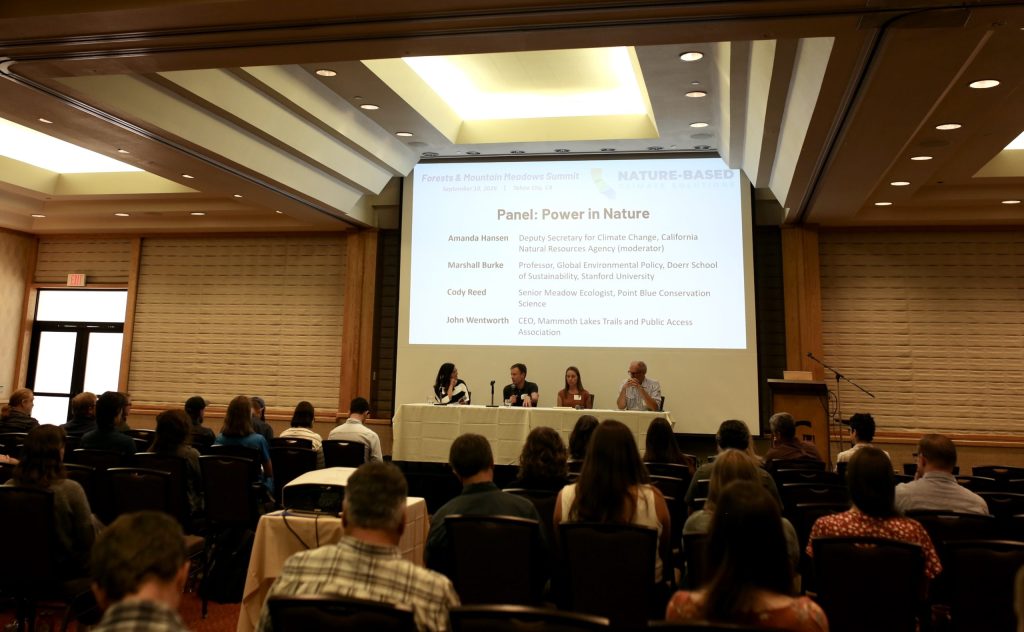
Cody Reed, senior meadow ecologist at Point Blue Conservation Science, explained mountain meadows’ diverse roles and value, from supporting biodiversity and improving water quality and flood attenuation to sequestering and storing carbon as a long-term nature-based solution.
Reed said many factors cause meadow degradation and loss, including development, grazing, and logging, which affect water quality, meadow plants, and the animals that rely on them. In terms of climate impacts, when meadows degrade, they also become sources of carbon, Reed explained, rather than sinks. Although meadow restoration may be expensive, Reed discussed its value and benefits, including how restored meadows sequester carbon for years and provide wildfire resilience, since what often survives a wildfire lies within these areas.
Another panelist, Marshall Burke, professor of global environmental policy at Stanford University’s Doerr School of Sustainability, explained that research has found massive societal benefits when landscapes are cared for. Using wildfire smoke as an example, he said the benefits are significant and exceed costs of even large-scale ecosystem restoration by a factor of 10. However, one challenge is the delayed gratification that comes from the time it takes to see results. Continuing with the wildfire smoke example, Burke explained that the state would have to prescribe-burn 500,000 acres a year for 10 years to see a 25% reduction in wildfire smoke.
“We can tell the scientific story of when the benefits show up,” he said, “but how best to communicate that to the public and help people understand that this is something we’re all in together, and it’s going to take some work to get there.”
Panelist John Wentworth, CEO of Mammoth Lakes Trails and Public Access Association, discussed how people’s perception of the natural environment compels them to travel and plays a role in driving economic activity. He also pointed to the influx of travelers and the opportunity to educate them. He shared photos of burn piles in the Mammoth Lake area around popular recreation locations, showing how they visually create the perception that something is being done to address wildfires and that visitors feel safer seeing them. “It’s meaningful,” he said. “It’s tangible.”
Innovating finance for these solutions
Finance was a major topic throughout the summit. To that end, the summit hosted a panel on innovative finance for nature-based solutions.
The summit also hosted an interactive tabling event with the State of California Wildlife Conservation Board, Sierra Nevada Conservancy, CAL FIRE, California Tahoe Conservancy and the California Department of Conservation engaging with attendees on state funding opportunities, especially after the passage of the 2024 $10 billion Prop 4 Climate Bond.

Emily Blackmer, director of government and community affairs at the Sierra Business Council, moderated the finance panel.
Zach Knight, CEO and Co-Founder of Blue Forest, which finances conservation projects, explained that when it comes to investing in nature-based solution projects, investors are looking to do good with their money and seek positive outcomes, even if the rate of return on their money is below other market rates of return.
“If they’re gonna give us their money,” he said, “and they’re gonna take a lower rate of return, they need to understand what the outcomes are, whether they care about water, fire risk reduction, carbon in the atmosphere, sedimentation transport. You’d be surprised what funders care about. They care about a lot of things.”
Stacy Caldwell, CEO of the Tahoe Truckee Community Foundation, discussed how throwing money at a problem doesn’t work without readiness on the ground.
“It’s kind of like pouring water on a desert floor. If the soil isn’t ready, you don’t absorb it into the things that you want to grow there, right?”
Calwell said that, when it comes to philanthropic giving, donors want to see impacts in their lifetime on specific things, and that it can be a challenge meeting that desire with current institutional philanthropic structures.
She also said that her team at TTCF is challenging themselves to stop thinking about the work in silos, for example, not talking about housing without talking about the workforce, and seeing the interconnectedness of topics and the importance of both public and private funders coming together collectively.
Dave Jones, former California Insurance Commissioner and the current director of the Climate Risk Initiative at the Center for Law, Energy & the Environment, UC Berkeley, discussed the Tahoe Donner community’s acquisition of insurance and how he worked to get the insurance sector to take into account risk reduction and ultimately make insurance more available for high-risk areas, and potential savings. Those savings can then be channeled back into nature-based solutions.
With Tahoe Donner, he said he persuaded an insurer to write a policy at a 34% premium reduction for the Tahoe Donner community, which had been actively managing acreage using thinning and prescribed fire for over a decade.
“So the big win was that the insurance company would not have written that insurance policy in a geography where the other insurers are pulling out,” he said, “but for the fact that there’s forest management occurring there, and we were able to demonstrate that their models could account for it, and they could then comfortably write an insurance policy and price it.”
He also emphasized the importance of practitioners in the audience sharing their work with local, state, and federal data collectors so insurers can use and incorporate it.
Jen Nevills, program manager for Bay-Delta Initiatives at the Metropolitan Water District of Southern California, discussed building a business case for investment in upper watersheds. Nevills discussed how traditionally water districts approached water challenges with infrastructure and technology, but how climate changes, including snowpack losses, precipitation and runoff pattern changes, and droughts, have incentivized looking at other solutions, like nature-based solutions of investing in watersheds.
Nature-based solutions idea lab
A networking activity rounded out the summit, with participants discussing successful elements they’ve seen in forest and mountain meadow restoration projects in a summit-ending nature-based solutions idea lab.
After breaking off into small groups, the summit came back together to discuss findings.
The idea lab identified funding and financing, partnership and coordination as top elements for successful projects, followed by policy, permitting and solutions, as well as political support.
Participants also reported partnerships, collaborations, and funding opportunities as key takeaways from the summit itself.
Many reported they are looking for more consistent, sustained funding to move their work on nature-based solutions forward.
For more information on nature-based solutions, visit resources.ca.gov/initiatives/expanding-nature-based-solutions.








Support Local Journalism
Support Local Journalism
Readers around the Lake Tahoe Basin and beyond make the Tahoe Tribune's work possible. Your financial contribution supports our efforts to deliver quality, locally relevant journalism.
Now more than ever, your support is critical to help us keep our community informed about the evolving coronavirus pandemic and the impact it is having locally. Every contribution, however large or small, will make a difference.
Your donation will help us continue to cover COVID-19 and our other vital local news.